
Criminal Court Cases in Richland County
The Richland County Circuit Court is part of Illinois's Second Judicial Circuit. It hears felony, misdemeanor, traffic, ordinance, juvenile, and other trial matters. Illinois does not split local criminal work between a county criminal court and justice-of-the-peace courts. Olney ordinance cases also route to circuit court rather than to a separate municipal criminal court. This gives a Richland County court case lookup one main local file custodian: the Circuit Clerk.
The clerk receives pleadings, orders, docket entries, judgments, and financial records. The State's Attorney creates the prosecution filings, and the judge creates court orders. Those are distinct from an officer's report or the jail's booking entry. Case numbers and complete names are the best keys for linking the records. A person who knows only an arrest date may need to find the matching case after the prosecutor files charges.
Richland Judici Search Routes
Richland County participates in Judici, a court-authorized portal for participating Illinois counties. It is not a single mandatory statewide court database. Richland's landing page leads to three useful routes: a case search, a charge search, and a court calendar. Basic searching is free, while some enhanced document access may require a Judici subscription.
The official Richland case-search screen shows the fields used to locate a docket.
Use the case route when a party name or case number is known. The other routes solve different tasks, so a blank result in one screen should not end the search.
Richland County Case Record Searches
Start with the narrowest reliable identifier. Spelling, name order, filing year, and case type can separate two people with similar names. Then compare docket facts rather than assuming the first name match is correct.
- Open Richland County's Judici landing page and select case search, charge search, or calendar for the task.
- Enter the full case number when available. Otherwise search by name and use a soundex option only when spelling is uncertain.
- Narrow the results by case category, filing range, or other displayed filters, then verify the matched party and court.
- Open the docket. Read each count, event, warrant entry, plea, judgment, and completion entry in date order.
- Call or visit the Circuit Clerk for a missing image, older file, copy, or certified disposition. Ask about current copy and certification costs before ordering.
| Field Label | Type | Required | Use |
|---|---|---|---|
| Last Name | Text | Yes for name search | Main party-name field |
| First Name | Text | No | Narrows common surnames |
| Middle Name | Text | No | Helps distinguish matches |
| Soundex | Checkbox | No | Finds similar name spellings |
| Case Number | Text | No | Best direct identifier when known |
| Case Type or Year | Filter | No | Reduces unrelated results |
If a person has several Richland matters, do not merge them into one history. Compare the filing year, case type, and number for each result. A calendar event belongs to one docket, while a charge search can return several cases that share an offense label. Save the full case number before calling the clerk. That number lets staff identify the right file and reduces the risk of ordering a record for someone with a similar name.
Richland Charge and Calendar Tools
A party search is not the only way into Richland court records. Judici's charge-search route can identify cases by charge criteria, while the court calendar helps locate scheduled proceedings. These tools answer different questions. A calendar entry establishes a scheduled event, not a conviction or final result.
The official charge-search view illustrates the separate route available for Richland County criminal cases.
After finding a charge-based match, open the full case and inspect every count. A filed charge can be amended, reduced, dismissed, or resolved differently from another count in the same case.
The linked Richland court calendar source also shows how date-based access is kept apart from the case index.
Confirm a court date on the current calendar or with the clerk. A past event can be continued, reset, or followed by a later order.
What a Criminal Case File Contains
A Richland County criminal case file is a dated record of what was filed and what the court did. The top-line status alone can hide the path of an individual count. Read the charging paper, docket, and final order together.
| Case Number & Court | Identifies the Richland Circuit Court matter and links later filings to the same case. |
|---|---|
| Charging Document | Lists the allegations the prosecutor filed; they may differ from booking labels. |
| Docket Entries | Chronological events such as filings, continuances, warrants, pleas, orders, and completion. |
| Hearing Dates | Scheduled and past events, which should be checked for later resets or results. |
| Disposition & Judgment | Shows the result for each count, including dismissal, acquittal, plea, or finding of guilt. |
| Sentence & Conditions | Records the ordered sanction, supervision, fees, probation terms, or prison commitment when applicable. |
Note: A police narrative, jail booking, ISP transcript, and court docket are separate records even when they concern the same event.
Richland Circuit Clerk Counter
Circuit Clerk Zachary Holder's office is at 103 W. Main Street, Olney, IL 62450, with the courthouse open Monday through Friday, 8 a.m. to 4 p.m. The clerk can answer file-access questions at (618) 392-2151. The official Circuit Clerk contact page is the right source for current office details.
The county contact image reinforces that certified court records come from the local file custodian, not from a search-results screenshot.
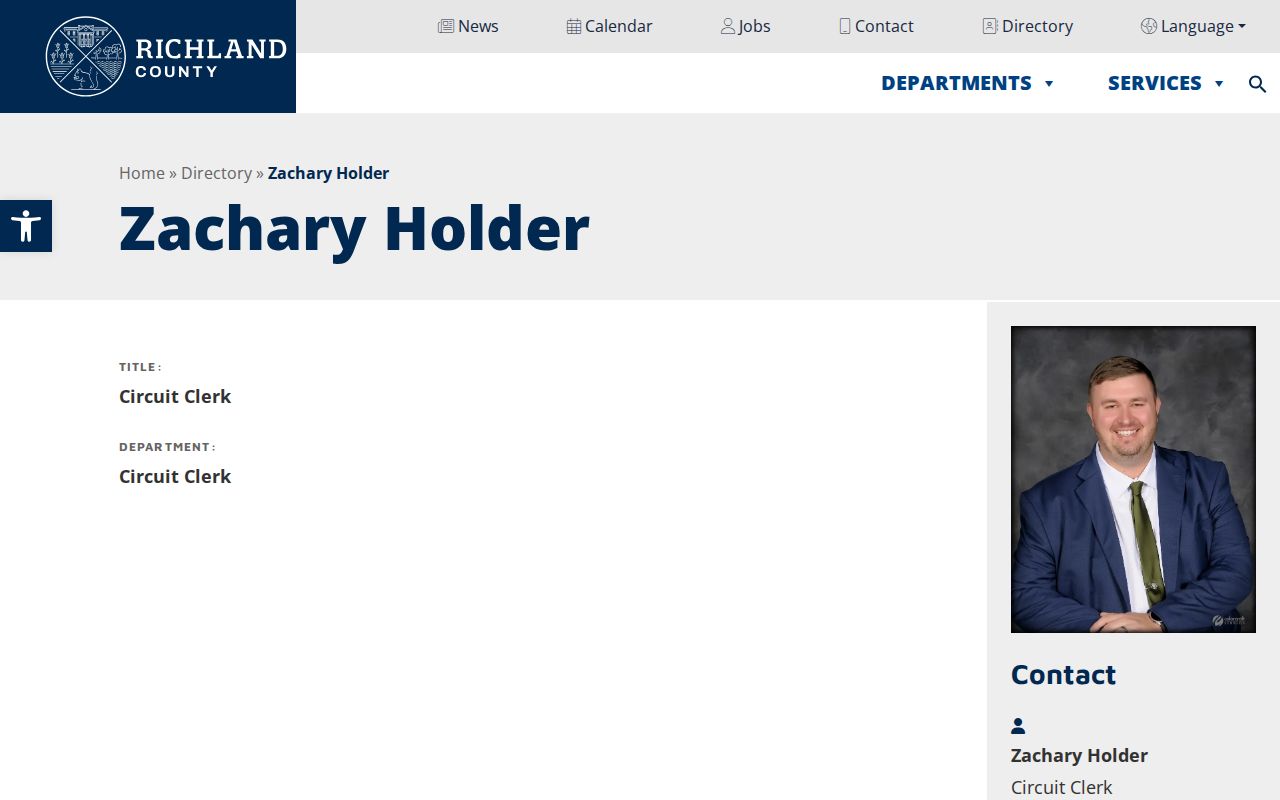
Ask for the exact document needed and whether certification is required. The research did not locate a current online criminal-copy fee schedule, so confirm per-page and certification charges before placing an order. Courthouse amenities include a public-access terminal, an e-filing kiosk, and a law library on the third floor.
Criminal Case Stages in Richland County
A local criminal matter may begin with arrest or summons, followed by a prompt first appearance and a pretrial-release decision. The State's Attorney then files a complaint or information, or seeks an indictment. Arraignment identifies the filed charges. Disclosure and motions come before a negotiated plea or trial, and the court enters judgment and sentence. An appeal may follow. Probation or an Illinois Department of Corrections commitment creates later records outside the basic trial docket.
Case flow: Arrest › Booking › Charging decision › First appearance › Arraignment › Motions › Plea or trial › Judgment › Sentence › Possible appeal
Since September 18, 2023, Illinois has used release conditions or detention decisions instead of cash bail. Older Richland docket entries can still display bond terms and dollar amounts. Treat those as historical entries, not a statement of current procedure.
Richland Charges and Final Results
The arresting officer records an alleged offense, the jail records a booking charge, and the State's Attorney decides what to file. Those labels may not match. Prosecutors can amend or reduce a count, and a judge or jury determines the result. For that reason, a charge-search hit is only a starting point.
- Complaint
- The charging document that begins many trial-court prosecutions.
- Disposition
- The outcome of one count, such as dismissal, acquittal, plea, or conviction.
- Nolle prosequi
- A prosecutor's formal decision not to continue a charge at that time.
- Failure to appear
- A missed required court appearance that may lead to a bench-warrant docket entry.
- Certified disposition
- A clerk-certified record of how the court resolved the charge.
Read each count independently and follow the event trail past the first filing. If Judici shows a charge but no clear result, request the final order or certified disposition from the Richland Circuit Clerk.
Missing or Cleared Richland Cases
Older files may have limited online images. Sealed, expunged, juvenile, and impounded matters are excluded from ordinary remote access, as are protected details such as victim or minor identities and private identifiers. A missing result therefore does not prove that no record ever existed. It may reflect the search spelling, filing lag, an older paper file, or a lawful access limit.
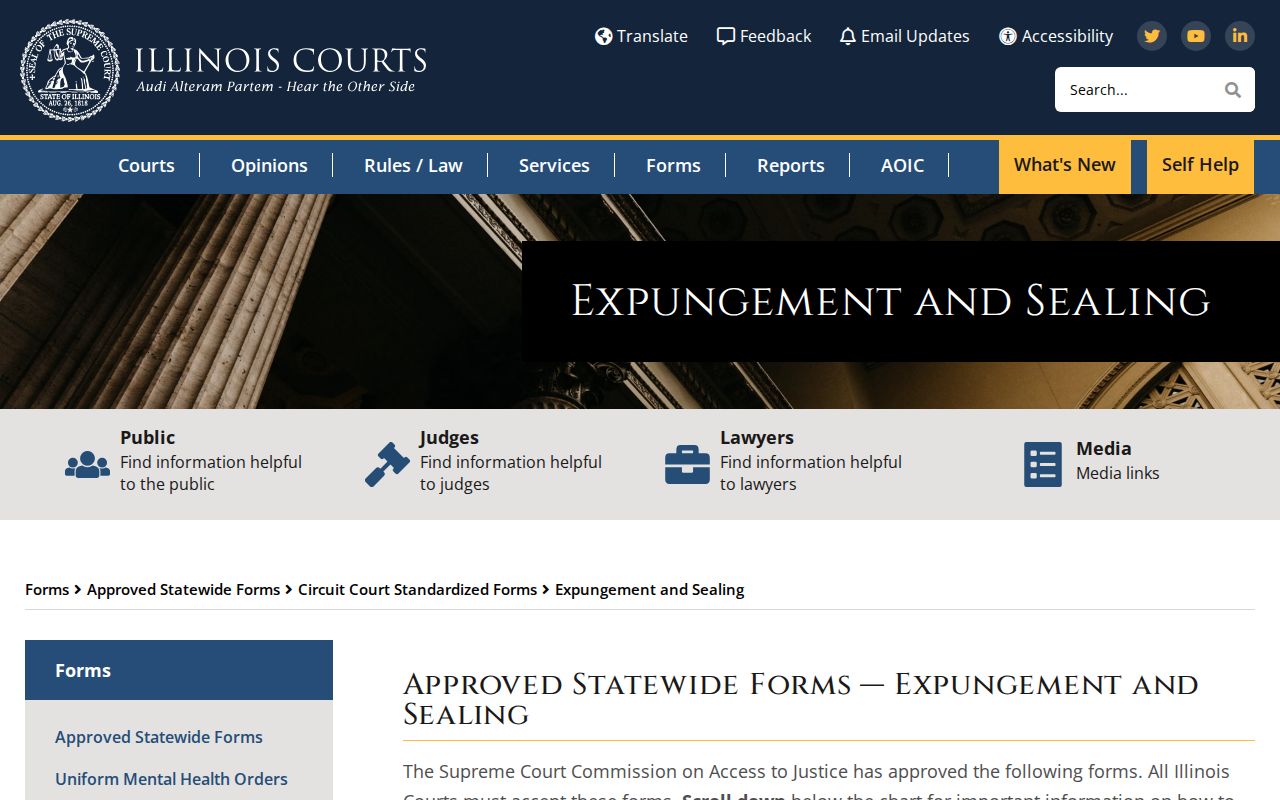
For one's own eligible record, Illinois uses both expungement and sealing under 20 ILCS 2630/5.2. The Illinois Courts approved form set includes the request, notice, order, and extra case pages. File the correct packet with the Richland Circuit Clerk, list each arresting agency and case, and ask about the local fee or statewide fee waiver. The State's Attorney, ISP, and arresting agencies receive notice and may object.
The official form source shows the record-clearing materials used for Richland filings.
A granted order must still be processed by the agencies. Recheck the official clerk record and use ISP Access and Review if repository data appears wrong.
Access Rules for Case Records
Illinois court files are generally open, but public access is not unlimited. The Illinois Supreme Court's electronic-access policy excludes sealed, impounded, juvenile, and protected information from remote display. Paper files can also contain redactions. Ask the clerk whether a record exists and what public portion may be inspected when the online index does not answer the question.
The Illinois Freedom of Information Act is useful for agency-created reports, but court files should be requested from the Circuit Clerk. FOIA permits defined exemptions and redactions, and it is not a substitute for criminal discovery. For public statewide conviction information, ISP CHIRP is a separate gated repository product. It does not replace a certified Richland County judgment.
Different access rules also explain why the same event can look different across systems. Judici reports public court activity, the sheriff holds booking material, and ISP maintains repository data. When facts conflict, identify which office created the disputed field and ask that custodian about correction. The Circuit Clerk is the source for a Richland judgment; ISP's Access and Review process is the route for one's own state transcript.